Public debate with stakeholders "Opportunities and challenges related to stimulating the green economy in agriculture and rural development in Serbia"

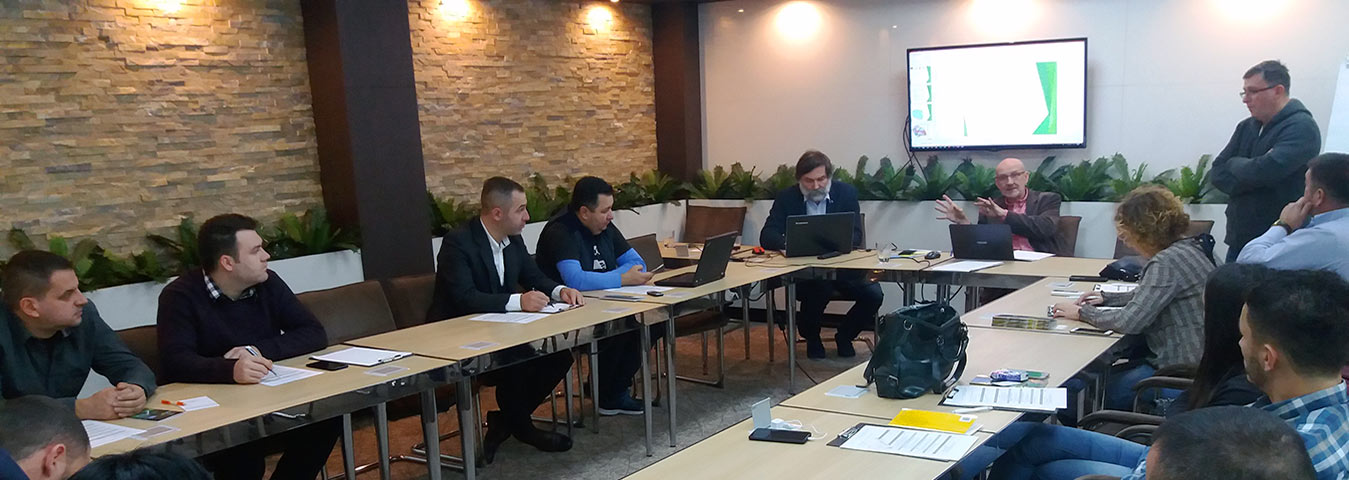
On Monday, March 29, 2021, a public debate with stakeholders was held in Vrnjačka Banja on topic - opportunities and challenges related to stimulating the green economy in agriculture and rural development in Serbia.

Public debate was conducted within the Networking and Advocacy for Green Economy project (NAGE) funded by the EU, where the Rural Development Network of Serbia is one of the partners.
The gathering was attended by over 20 participants - mostly representatives of CSOs from Serbia.

Organic agriculture, experience of Poland

Mariusz Maciejczak, professor from department of Economics and Organisation of Enterprises from Institute of Economics and Finance SGGW and also expert of Polish Centre for Accreditation, gives insight to European Union food quality standards and its impact on the development of the agri-food sector in Poland, that include three main elements: food security, food safety and food quality.

Innovation in agriculture and empowering women in agri-food

Aleksandra Niżyńska provides examples of activities run or supported by EIT Food, Europe’s leading food innovation initiative. These are, among others: HUB Hackaton: Future Food, which gathered more than 100 hackathon participants, mentors and speakers from all over the Baltics and Scandinavia, while the winning team received tickets to an industry event in the Netherlands and one of the winning teams participated in EIT Food Innovation prize.

Vertical farms, where crops are grown all year round

Precision farming and robotics systems will enable farms to become more profitable, efficient and environmentally friendly. This function is already performed by vertical farms, where crops are grown all year round, using much less water and energy than traditional agriculture. Vertigo Farms, the plants are not only cultivated in a completely ecological way, but also thanks to supercritical extraction with carbon dioxide they obtain maximum nutritional value.

The main problems of farmers in Poland, as experience of Serbian farmers

Łukasz Czech provides lecture from the perspective of a farmer, entrepreneur and rural advisor, based on his personal, practical experience. Experts presents current main problems of farmers in Poland, including access to capital, contact with administration, problem with sales and prices, lack of water, unfair position of retailers; shattered structure of agriculture, as well as low bargain position, which is a crucial issue for farmers. 

High Nature Value Farming, two EU funded initiatives - cluster projects implemented in Poland

Wojtek Szpociński, chairman of the Development Policy Foundation provides examples of two EU funded initiatives - cluster projects implemented in Poland, dealing with certain areas related to High Nature Value Farming: Conservation and recreation of wetland habitats in Biebrza Valley, being one of Natura 2000 Area in Poland and the project Carp Valley, regarding “Living Eco-Communities” implemented in Western Malopolska. 

Approved projects for funding under the NAGE Grants Program

In front of the partner consortium, Network for  Rural Developmen of Serbia has completed the selection of project proposals that will be implemented on the territory of the Republic of Serbia within the call "Support to civil society organizations within the NAGE project - Networking and Advocacy for Green Economy".

Out of a total of 31 received project proposals from civil society organizations, 6 projects were approved for funding, as follows:

Training “Green Economy and Entrepreneurship”

In the period from June 16th to 18th, 2020, the Network for Rural Development of Serbia held a program-specific training "Green Economy and Entrepreneurship". The training was realized in Mala Remeta on Fruška Gora in the restaurant “Lugarnica” within the Networking and Advocacy for Green Economy project (NAGE) which is financed by the European Union, where the Network for rural development of Serbia is one of the partners.

Social Innovation in Marginalised Rural Areas

Social Innovation in Marginalised Rural Areas (SIMRA) is a project funded by the European Union's Horizon 2020 research and innovation programme.

SIMRA seeks to advance understanding of social innovation and innovative governance in agriculture, forestry and rural development, and how to boost them, particularly in marginalised rural areas across Europe, with a focus on the Mediterranean region (including non-EU) where there is limited evidence of outcomes and supporting conditions.

Two very important documents were prepared within the project: